Point fighters know the feeling.
The gym floor is ready. The athletes are sharp. The crowd is loud. Every exchange matters.
Then the event ends.
The bracket closes. The medals are handed out. The fighters return to their gyms and wait for the next tournament.
But what if point fighting had something more?
What if elite black belts could represent their city through an entire season? What if rivalries had history? What if fans followed team standings, debated lineups, and argued over the next championship matchup?
What if point fighting finally had a professional league?
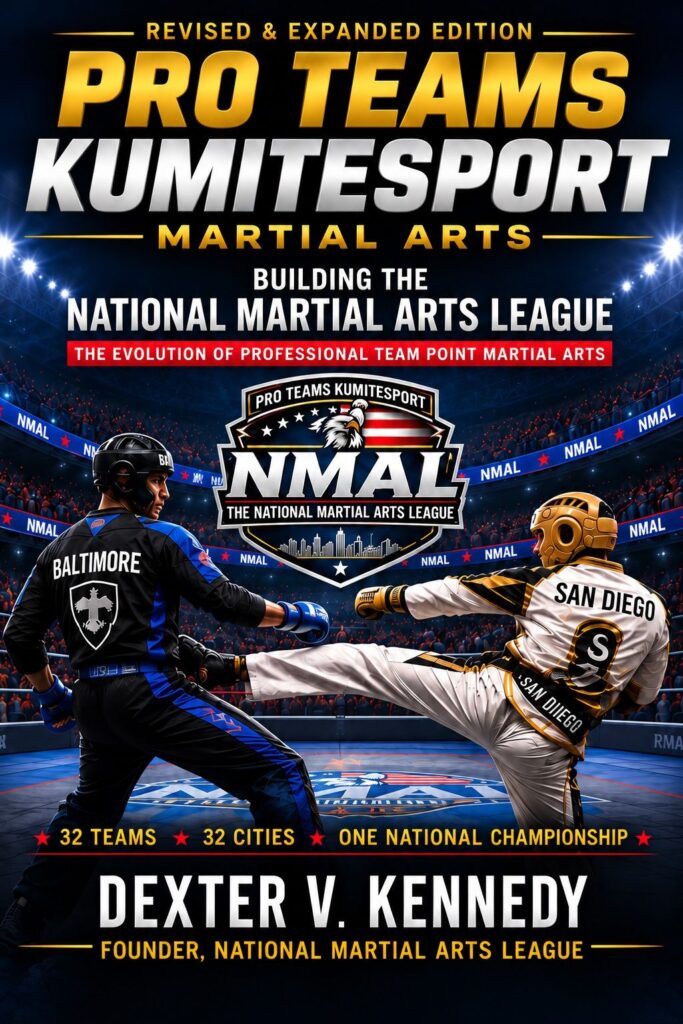
That is the question behind Pro Teams KumiteSport: Martial Arts, Building the National Martial Arts League, the revised and expanded book by Dexter V. Kennedy.
It is a blueprint for taking point fighting from isolated events to a professional team sport.
A New Path for the Point Fighter
The modern point fighter trains for years to develop timing, control, speed, distance, and composure.
Those skills deserve a professional stage.
The book maps out a league built around the athletes who make the sport compelling:
- Elite black belts competing under official city banners.
- Teammates preparing together for a full season.
- Coaches building lineups around styles, strengths, and fight intelligence.
- Fans forming lasting connections with their home teams.
- Rival cities meeting again and again on the floor.
- A postseason where every exchange carries greater weight.
This is not simply another tournament format.
It is a professional pathway.
A fighter would not compete only for a medal at one event. A fighter would compete for a team, a city, a season, and a place in league history.
That changes everything.

The 32-Team, 32-City Vision
At the center of the book is a 32-team, 32-city league model.
The concept is direct. Every team represents a city. Every city develops an identity. Every athlete steps onto the floor carrying more than an individual name.
They carry a banner.
That city-based structure gives point fighting something fans understand immediately: belonging.
A team can become part of the rhythm of a city. Local athletes can compete for a professional organization close to home. Supporters can follow their roster, defend their team, and build traditions around recurring events.
The league model creates room for different team personalities:
- The disciplined technical squad.
- The relentless pressure team.
- The young roster built around emerging black belts.
- The veteran-heavy team with championship experience.
- The city team known for tactical precision.
- The team that never gives up a lead.
That is where fan debate begins.
Which city has the deepest roster? Which team has the best anchor fighter? Which coach makes the smartest substitutions? Which rivalry will define the season?
A national league gives fans reasons to keep watching after one event ends.
Home and Away Competition Builds Real Rivalries
One of the book’s defining ideas is regular home and away competition.
That structure gives teams repeated opportunities to meet. It creates history between cities. It makes each matchup part of a larger story.
A home event should feel different from an away event.
The home team walks into a familiar environment. Local supporters know the athletes. Teammates draw energy from the crowd. The city’s identity is present in the venue, the colors, the introductions, and the noise around the floor.
On the road, the challenge changes.
The visiting team must stay composed in an unfamiliar setting. Fighters must handle the pressure of another city’s crowd. Coaches must prepare athletes to remain focused when the energy is against them.
That is how rivalries become meaningful.
Not through one meeting.
Through repeated battles.
Through close decisions, disputed exchanges, comeback victories, and rematches that fans have been waiting to see.
A Regular Season That Rewards Consistency
A professional league needs more than a single championship event.
It needs a season.
The book outlines a structure that includes the regular season, postseason competition, and the road to the NMAL National Championship.
That creates a different test for athletes.
A tournament rewards a fighter who peaks on one day. A season demands consistency.
Fighters must prepare for different opponents and different tactical problems. They must manage pressure across multiple events. Teams must build depth. Coaches must identify which athletes are ready for particular matchups.
Every point matters.
Every win affects the standings.
Every loss creates a question for the next event.
The regular season gives fans a reason to follow the league week after week. It gives teams time to build momentum. It gives athletes the opportunity to establish themselves as reliable professionals rather than one-event surprises.
And it creates the kind of debates that define sports communities:
- Who is the most valuable fighter in the league?
- Which team is strongest under pressure?
- Is the best individual fighter always the best team competitor?
- Should a coach favor experience or emerging talent?
- Which city can handle the longest road stretch?
- Who deserves the final roster spot?
The floor provides the answers.
From the Postseason to the NMAL National Championship
The postseason is where a professional season becomes a legacy.
Regular-season success earns a team the right to continue. But the playoffs demand another level of focus.
The pace is different. The pressure is heavier. The margin for error is smaller.
One exchange can swing a bout. One bout can swing a team match. One team match can determine who moves forward.
The book maps out the road toward an NMAL National Championship, giving the league a clear competitive destination.
That destination matters to fighters.
A championship is not only a trophy. It becomes the reference point for every future roster. It becomes the standard new athletes are measured against. It gives cities a reason to celebrate and rivals a reason to return stronger.
The first champion will always be remembered.
So will the teams that came closest.

What the Book Covers Beyond the Floor
Although the book begins with the sport and its athletes, a professional league requires a complete operating structure.
The revised and expanded edition covers the major pieces required to build and sustain that structure, including:
- The 32-team, 32-city league model.
- Athlete competition and team-based point fighting.
- Team ownership.
- Host cities and permanent local presence.
- League economics.
- Capitalization.
- Regular-season scheduling.
- Postseason competition.
- The road to the NMAL National Championship.
These sections explain how the competition can function beyond a single event.
They show how teams can be organized. They examine how cities can support a permanent professional presence. They provide a framework for connecting athletes, coaches, operators, fans, and league leadership.
The business elements serve the competition.
The purpose is to build a system where elite fighters can compete consistently, teams can develop recognizable identities, and fans can follow the sport with the same intensity they bring to other professional leagues.
Why Fans Should Pay Attention
Fans are the energy behind every professional sport.
They choose a team. They debate selections. They remember controversial decisions. They celebrate breakthrough athletes. They travel to rivalry events. They argue about who should have been in the starting lineup.
A professional point-fighting league gives that energy somewhere to go.
It gives supporters:
- A team to follow.
- A city to represent.
- A schedule to anticipate.
- Rivalries to discuss.
- Athletes to discover.
- Standings to track.
- Playoffs to debate.
- A championship to chase.
That is the larger vision behind Pro Teams KumiteSport.
Not point fighting as a collection of disconnected competitions.
Point fighting as a national sports property built around real athletes, real teams, and real city pride.
The Giveaway Ends September 30
Readers can enter the Goodreads giveaway for a chance to win a free Kindle copy of Pro Teams KumiteSport: Martial Arts, Building the National Martial Arts League.
The giveaway runs from September 15 through September 30, 2026, with 100 copies available for eligible U.S. readers.
Enter the Goodreads giveaway or add the book to your reading list.
For readers who do not want to wait, the Kindle edition is currently available at the reduced price of $2.99.
That makes this the right time to read the blueprint, study the structure, and decide what professional point fighting should become.
Your City. Your Team. Your Legacy.
The question is no longer whether point fighters are ready for a professional platform.
The athletes are ready.
The coaches are ready.
The cities are waiting for teams to represent them.
The real question is this:
What happens when point fighting finally has a league built for the way elite fighters actually compete?
Read the revised and expanded edition of Pro Teams KumiteSport: Martial Arts, Building the National Martial Arts League.
Enter the giveaway before September 30.
Or grab the $2.99 Kindle edition and see how the road to the NMAL National Championship is mapped out.
Your City. Your Team. Your Legacy.